Redefine Success
Women rewriting the rules of education in Pakistan
Three Acumen Fellows are breaking down barriers to learning and building institutions designed to last.
October 14, 2026
In Pakistan, a child's education can end for reasons that have nothing to do with ability: a family that values marriage over a degree, a missing form that keeps a domestic worker's child out of school, a curriculum taught in a language no one speaks at home. The problem isn't a lack of will to learn; it's the walls built around who gets to.
What does it take to tear one of those walls down? Three women founders in Acumen's Foundry offer an answer. Sumera Mehboob started a school for girls in her guest room in Balochistan. Sehrish Saddozai opened a classroom for three children of domestic workers in Rawalpindi and grew it into a 500-student school. Maira rebuilt literacy education around Urdu, a language Pakistan's schools had long treated as second best. None of them set out to become founders. Each started by confronting a problem she could no longer accept — and then kept building.
Sumera Mehboob, Founder of Mechanism for Rational Change
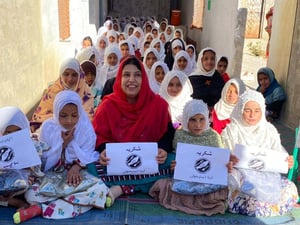 In Balochistan, where girls and women face significant barriers to education and employment, Sumera had already fought to make both possible in her own life. She fought for her own schooling, then for the right to work, and spent a decade inside development organizations watching other people design solutions for girls whose lives reflected parts of her own. Eventually, she decided she needed to be the one building those solutions.
She funded the idea herself with savings that were meant to secure her own future: her provident fund and marriage jewellery. In 2014, she established Mechanism for Rational Change (MRC) without donors or guaranteed funding, despite relatives who asked why she was giving up a steady income. She ran it from the baithak — the sitting room — of her own home, while neighbors came to the door asking why strangers were coming and going.
With that confidence came room to build the larger vision she had been carrying. MRC moved beyond the single classroom and developed its Educational Champions model, bringing the same approach into other schools and communities. That model has since reached more than 650 students. Its one-year leadership program has equipped more than 1,900 young people ages 18 to 25, and its skills and entrepreneurship work has helped launch 63 youth-led enterprises.
Then came a test no one had planned for. When schools closed during COVID-19, MRC was the first institute in the region to move its classes online, and Sumera trained mothers who had never used WhatsApp so their children could keep learning. Voice of America covered her story: the woman who had once opened a school in her sitting room was now helping her community figure out how education could continue when classrooms closed.
Sehrish Saddozai, Founder of Fareezah Education
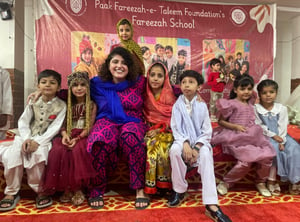 The problem found Sehrish in her own home. Her house help's children were not in school, and when she asked why they were not attending the government school, which charges no tuition, the answer was a single missing document. The family had moved from another region and did not have B-forms, the identity documents required for school admission.
Sehrish soon realized this was not one family’s problem. Many households in Kotha Kalan, Rawalpindi, had migrated from other parts of the country, and the same missing documentation was keeping their children outside the formal school system.
She tried the obvious fix first, getting the children admitted to a local private school, where they thrived academically. But the arrangement quickly fell apart: the children did not fit in, and Sehrish came to feel that the school had taken them only for the fee.
Starting a school of her own frightened her more than paying someone else's fees ever had, but she did it anyway.
Fareezah opened in 2016 with three children. For years, Sehrish held a full-time job during the day and ran Fareezah in the evenings. She and her mother made home visits to persuade parents to enroll their children and keep them attending, while Sehrish worked to create a school that looked and felt like the formal education those families had long been excluded from.
Three students became a borrowed room, then a rented three-room apartment, and eventually a dedicated building with 18 classrooms and more than 500 students. Today, Fareezah educates an estimated 80 to 85 percent of the children in Kotha Kalan.
But as the school grew, Sehrish encountered a different kind of constraint: she had built an organization in which nearly everything still depended on her.
The Acumen Fellowship helped her recognize that building something sustainable would require a different kind of leadership.
Learning to step back did not happen all at once. During the Fellowship, she started thinking about delegation, shared responsibility and the systems a school needs to outlast the founder who built it. Afterwards, she began deliberately removing herself from decisions she had always owned and building a team capable of making them.
Today, the work is spread across the organization rather than resting on her. A core team and an advisory board work alongside her on fundraising, supervision, and strategy, while a separate management team runs the schools day to day.
Fareezah has also expanded beyond its original classrooms through university collaborations, educator training, and a fellowship program of its own. What began as one woman covering another family's school fees is becoming something larger: an institution, designed to keep working even when its founder is no longer at the center of every decision.
Maira Siddiqui, Founder of Chiragh Education
 For Maira, the barrier was not access to a classroom, but the language inside it.
She grew up in an Urdu-speaking family with deep ties to the language, yet attended English-medium schools and, for years, believed English was the measure of a good education. It took leaving Pakistan for her to begin questioning that assumption.
While studying in the United States, she watched international students hold onto their own languages with pride and treat English as one more tool, rather than a replacement for their identity.
Back in Pakistan, that realization became tangible in a Karachi classroom. While teaching in schools serving low-income communities, she walked past a class where a teacher was teaching math in Urdu. The children understood. They were following along.
For Maira, it crystallized something she had been beginning to question: children who struggled in English were not necessarily struggling to learn. The language of instruction itself could be standing between them and the lesson. The children were falling behind because they were being taught in words they did not own.
She started Chiragh Education to put the mother tongue, the language children already understand, back at the center of learning.
Building the solution required her to rethink more than the curriculum. Her first app was scrapped once she realized that developing a product was only one part of the challenge; getting people to use and pay for it was another. She built again, an Urdu game-based learning app and piloting it with 600 children in Sindh, who scored around 70 percent on average.
But one of the deepest barriers was cultural:convincing parents and educators that Urdu was worth teaching in at all, against an instinct that reaches for English by reflex.
Her answer to that instinct was simple.
"We will always be Pakistani. We have to accept that and be proud of that."
The Acumen Fellowship came as Maira was confronting another challenge familiar to many founders: she had made herself responsible for solving every problem. Chiragh could only grow as quickly as she could put out fires.

.png)