Redefine Success
The Acumen Fellowship: Where Trust Takes Root
How a conversation between two Fellows became a cross-border agricultural enterprise — and what it reveals about the relationships that make building possible.
July 2026
By Oyindamola Adegboye & Joy Abegunde
In northern Nigeria, Rejoice Usim has spent years turning tomatoes, onions, and peppers into shelf-stable products — and, in the process, building Simkay Foods into a route to market for farmers who would otherwise lose entire harvests to spoilage before they could sell them. A few borders to the west, in The Gambia, Beran Dondeh Gillen has spent her career at the intersection of business, digital transformation, and agriculture, most recently as a consultant on the ROOTS Project, an IFAD-funded initiative strengthening smallholder farmer livelihoods across the tomato, onion, and rice value chains.
Two women. Two countries. The same problem, approached from opposite ends of West Africa. For years, neither knew the other existed. In 2025, the West Africa Acumen Fellowship brought them into the same room.
Where it Started
They met at an Acumen Fellowship Immersive in Ghana. What began as conversation quickly became recognition: the post-harvest losses Beran watched undermine Gambian farmers season after season were the very losses. Rejoice had spent years learning to prevent in northern Nigeria. The problem Beran lived with was the problem Rejoice had solved.
The obvious question followed: could that hard-won knowledge travel? Rather than theorize about it, the two Fellows decided to find out. Within months, they had organized a study tour to Nigeria, bringing a Gambian delegation, including officials from the Ministry of Agriculture, food processors, vegetable growers, and other agricultural stakeholders, to see Rejoice's operation firsthand.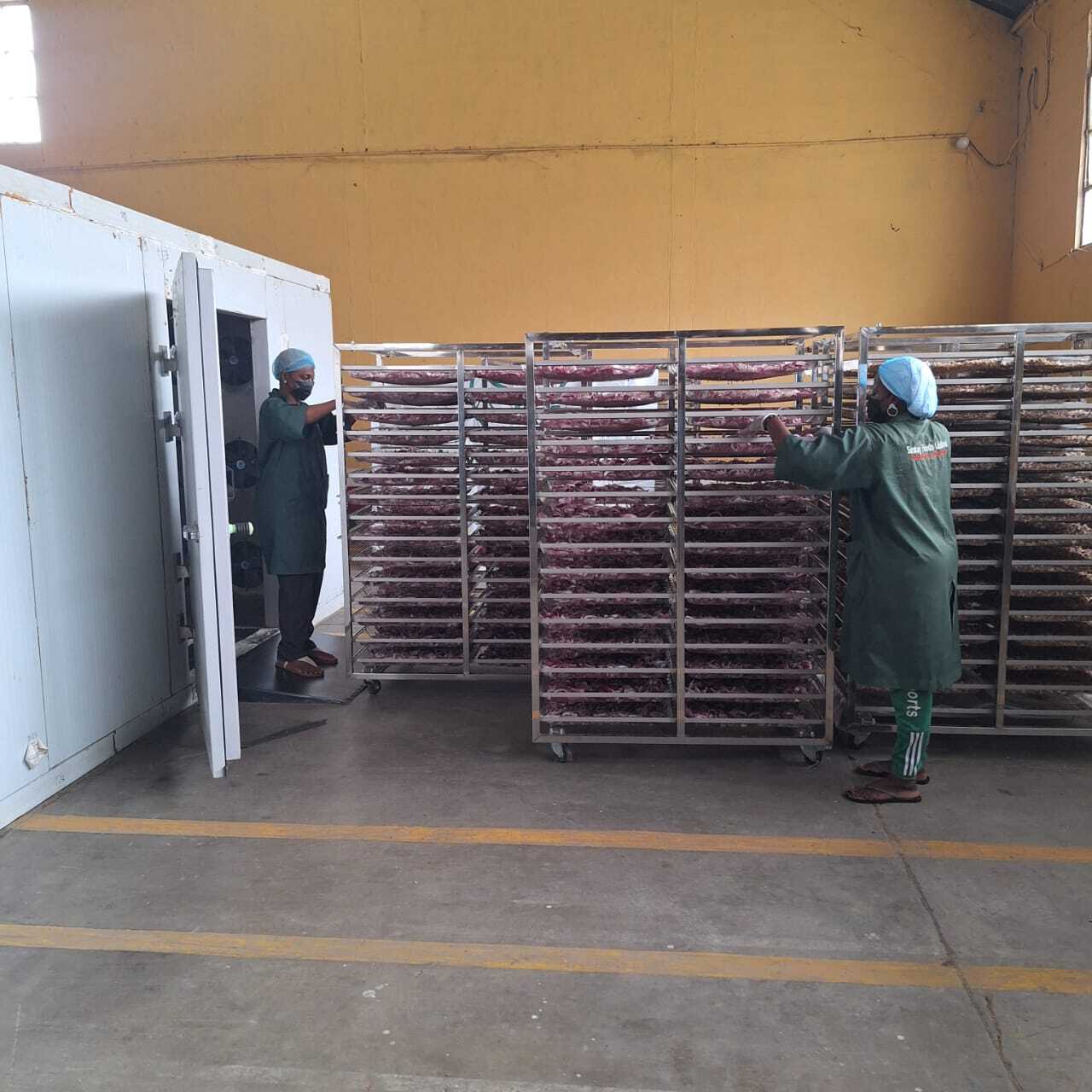
An Eye-Opening Discovery
What the delegation found in Nigeria reframed the problem entirely.
Through the ROOTS Project, The Gambia had already deployed four industrial-grade drying machines across its farming regions. The hardware was in place. Yet the machines sat largely unused because the technical knowledge needed to operate them had never reached the communities meant to benefit from them.
Then, the delegation walked into Rejoice’s facility and watched her team operate the exact same machines — efficiently and effectively, every day.
“It was an eye-opening experience,” Beran recalls. The ROOTS team, she explains, couldn't believe they had invested in this equipment only to leave it idle, simply because no one had shown the farmers how to unlock its potential.
The missing ingredient, it turned out, had never been capital or equipment. It was knowledge. And now they knew exactly where to find it.
From Realization to Enterprise
The gap Beran kept running into with the ROOTS Project — reliable processing infrastructure and the know-how to operate it — was precisely the gap Rejoice had built a company to close. The study tour turned that overlap into a plan.
The result is Simkay Foods Gambia, a new enterprise co-founded by Beran and Rejoice to bring processing capacity, market linkages, and technical knowledge directly to Gambian farming communities. And the two are not waiting for permission to begin. The company has already legally registered, a factory space has been identified, and bank accounts are being opened. Rather than wait for grant funding, Beran and Rejoice are moving ahead using their own initial capital to procure equipment, secure land, and prepare the factory.
The momentum has been hard to miss. One grant application went in while Rejoice was still sitting at the airport, on her way home from The Gambia.
Their rollout is deliberate. Market entry begins with spices, ginger and turmeric, before expanding into the offtake and processing of onions, tomatoes, and peppers later in the year. Further out, the partners are exploring primary production of bell peppers, with the goal of loosening The Gambia's dependence on vegetable imports from neighboring Senegal.
Why The Gambia
The Gambia was not a random choice. Even before the Fellowship, Rejoice had been exploring regional export opportunities, fielding interest from markets like Ghana and Senegal. But The Gambia stood out. Its agricultural ecosystem mirrors northern Nigeria’s in ways that make knowledge transfer unusually practical — a similar climate, aligned crop calendars, and compatible seasonality. “I saw it as a bedrock for reaching other West African markets,” Rejoice explains.
Beyond the strategic logic, sits a more personal one. Across Gambian farming communities, post-harvest loss continues to erode farmer incomes, particularly for women farmers. Entire harvests of tomatoes and onions spoil for want of processing and market access. For Rejoice, seeing it up close landed hard. “The women are putting in so much,” she says. “And at the end of the day, many are still living in poverty. The least I can do is share the knowledge we have.” For Beran, who has watched that waste repeat season after season, the partnership is something long overdue. 
An Unexpected Dividend
The collaboration also gave Rejoice something she had not gone looking for.
Hosting the Gambian delegation exposed her to a level of public-private coordination she had not considered central to her growth strategy. As a private-sector founder, she had largely assumed that scaling meant building alone. The visit suggested otherwise. In its wake, new relationships began forming with institutions in Kaduna State, where Simkay is based, and government stakeholders reached out to learn more about her work. A partnership conceived to open a Gambian market had widened her possibilities inside Nigeria, too.
The numbers hint at how far this could reach. The ROOTS Project currently supports 29 of roughly 139 garden clusters across The Gambia, and Beran and Rejoice see room to eventually work across many more. If the model holds, it could cut post-harvest losses, lift incomes for women farmers, create jobs for young people across processing and distribution, widen local market access, and open new regional trade routes.
The Acumen Fellowship: A Bridge to Trust
Ask either woman why this worked, and neither points to a business plan. They point to trust.
“One of the hardest parts of any business partnership is trust,” Beran says. It is also the slowest thing to build. Two strangers with perfectly aligned interests can spend a year circling each other before either commits real money or reputation to the other. Beran and Rejoice didn’t have to circle.
They moved quickly because the Fellowship had done the foundational work. The Acumen Fellowship convenes a cohort of leaders who have each come through the same demanding selection and who spend months working through the same hard questions about values, integrity, and what moral leadership actually demands. So by the time Beran and Rejoice sat down together in Ghana, they were not strangers sizing up each other’s credibility from scratch. They already shared a language, set of values, and a hard-won confidence that the other would act with integrity. That is what allowed a single conversation to become a study tour, a study tour to become a company, and a grant application to be filed from an airport.
For an ambitious builder, this is the part worth sitting with. The Fellowship doesn’t hand you a market, a co-founder, or a grant. What it offers is rarer and far harder to manufacture: a room full of people you can trust enough to move quickly with, and the relationships that turn a good idea into action before the moment passes. In a region where so much depends on who you know — and on whether you can rely on them — that is not a soft benefit. It is often the difference between an opportunity noticed and an opportunity seized.
It is also how change compounds. What started as a relationship between two Fellows is becoming a working model for regional cooperation rooted in shared purpose, mutual learning, and a commitment to build systems that create lasting opportunity. For Acumen, that is the point: leadership development is the seed, not the harvest. It’s where the work begins, not where it ends. And the return shows up when individual growth becomes collective action.
The Work Ahead
The first products have yet to reach the market. The factory is still taking shape. But for the women farmers of The Gambia who have long had the harvest without the means to preserve or sell it, what Beran and Rejoice are building is a change that is long overdue.
And that is often how systems change begins. Not with a grand plan, but with two people who decided to act on what they already knew, and trusted each other enough to start.
.png)