Business Strategy
An introduction to impact markets
How social innovators can get started with impact markets
December 5, 2025
Across the world, social innovators are building solutions to tackle poverty, climate change, and inequality. Yet many face the same challenge: traditional funding doesn’t always provide the flexibility, scale, or incentives needed to grow their impact.
That’s where impact markets come in. Within these markets, financial instruments tie funding to results, and are gaining traction among investors, governments, and corporations who want accountability alongside impact. But for many social innovators, the landscape is still new and often confusing. What are these markets? Who uses them? And what resources do you need to get started?
This blog introduces the key concepts behind impact markets, explains why they’re on the rise, and shares insights from a webinar hosted by Acumen featuring three organizations putting them into practice.
Sikai Chen, Practice Lead (Innovative Finance) of Tri-Sector Associates, who designs innovative finance and results-based finance models connecting governments, investors, and social enterprises.
Vinay Sharma, Associate Director at rePurpose Global, who leads plastic recovery programs with more than 350 global brand partners.
Meredith Muthoni, Head of Electric Finance at BURN Manufacturing, who has helped scale clean cookstove access through carbon markets.
Their stories and lessons help demystify impact markets and provide practical tips for any social innovator looking to take the next step.
Why impact markets are on the rise
For decades, funders have allocated support for program inputs based on their likelihood to deliver outputs, such as how many people were trained or how many products were distributed, with actual outcomes only being tracked through lagged reporting. Impact markets flip this model by paying for outcomes: actual improvements like learning gains, lower emissions, or healthier communities that are independently verified.
This shift didn’t happen overnight. Governments, under pressure to show that taxpayer funds are used effectively, began experimenting with performance-based contracts. Private investors, eager to blend financial and social returns, started exploring ways to back enterprises that could prove their value. And advances in data collection made it easier to measure impact credibly.
All of this creates fertile ground for impact markets, where the value of social and environmental outcomes can be monetized. The logic is simple: If your enterprise reduces pollution, conserves biodiversity, or improves health, that outcome has value not just to your customer, but to society at large. The right financing tool allows you to capture that value and reinvest in your mission.
Impact markets at a glance
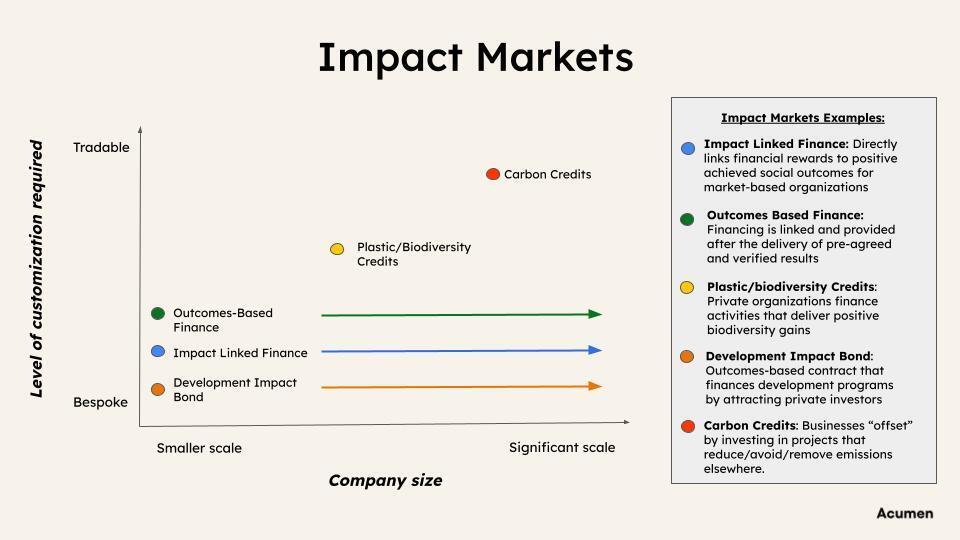
Impact markets aren’t one-size-fits-all. Different tools work for different organizations, depending on stage, capacity, and goals. Here are five commonly used tools:
- Impact-linked finance: Here, traditional financial tools (such as debt) are altered to financially reward positive impact performance from private companies. This includes impact-linked loans, where social enterprises receive lower interest rates for meeting impact targets. Sustainability-linked loans (SLL) are another tool used by corporations, where loan terms improve if the company meets ambitious ESG targets.
- Outcomes-based financing (OBF): Instead of paying for activities, funders only pay when pre-agreed results are achieved. Investors usually provide upfront capital, repaid once outcomes are verified. If the project achieves the predetermined outcomes (for example, lives reached), investors are paid back by “outcome funders” (for example, an aid agency or a philanthropic foundation). It’s flexible and performance-driven but requires strong data systems and independent verification. One example is a development impact bond, which offers upfront funding for a project in a developing country from private investors.
- Carbon credits: These tradeable credits are bought and sold on a market, and allow carbon-emitting companies to pay for their emissions. The companies that remove or offset carbon in the environment can sell their credits (one ton of carbon avoided = one credit) and often have their credits verified by a third party.
- Biodiversity/plastic credits: These tradeable credits are bought and sold on a market, and allow carbon-emitting companies to pay for their emissions. The companies that remove or offset carbon in the environment can sell their credits (one ton of carbon avoided = one credit) and often have their credits verified by a third party. Similar credits have emerged in recent years, including biodiversity credits and plastic credits.
Each of these tools carries its own demands, from the degree of data sophistication to the types of partners needed. But they all share the same DNA: rewarding measurable outcomes.
Who pays for outcomes?
Impact markets only work if there are actors willing to pay for results. Broadly, there are three categories and each group has its own motivations and challenges.
- Public and government funders: These agencies see results-based financing as a way to save costs while achieving social goals. For example, paying for programs that prevent illness or reduce pollution can ease future budgets. But governments often face bureaucratic hurdles, limited data systems, and risk aversion.
- Impact investors and philanthropists: Investors supply the upfront capital, and philanthropists often provide catalytic grants that absorb risk or reward impact. Their challenge often lies in measurement; without consistent methods, it’s hard to compare investment-ready projects or opportunities. They’re also constrained by the mismatch between high risk and modest returns.
- Corporations: Some corporates use impact tools for CSR, others view them as a way to shape markets and expand access. Yet concerns about greenwashing and internal misalignment can often hold them back. Our previous blog shares how corporations are moving from compliance to competitive advantage.